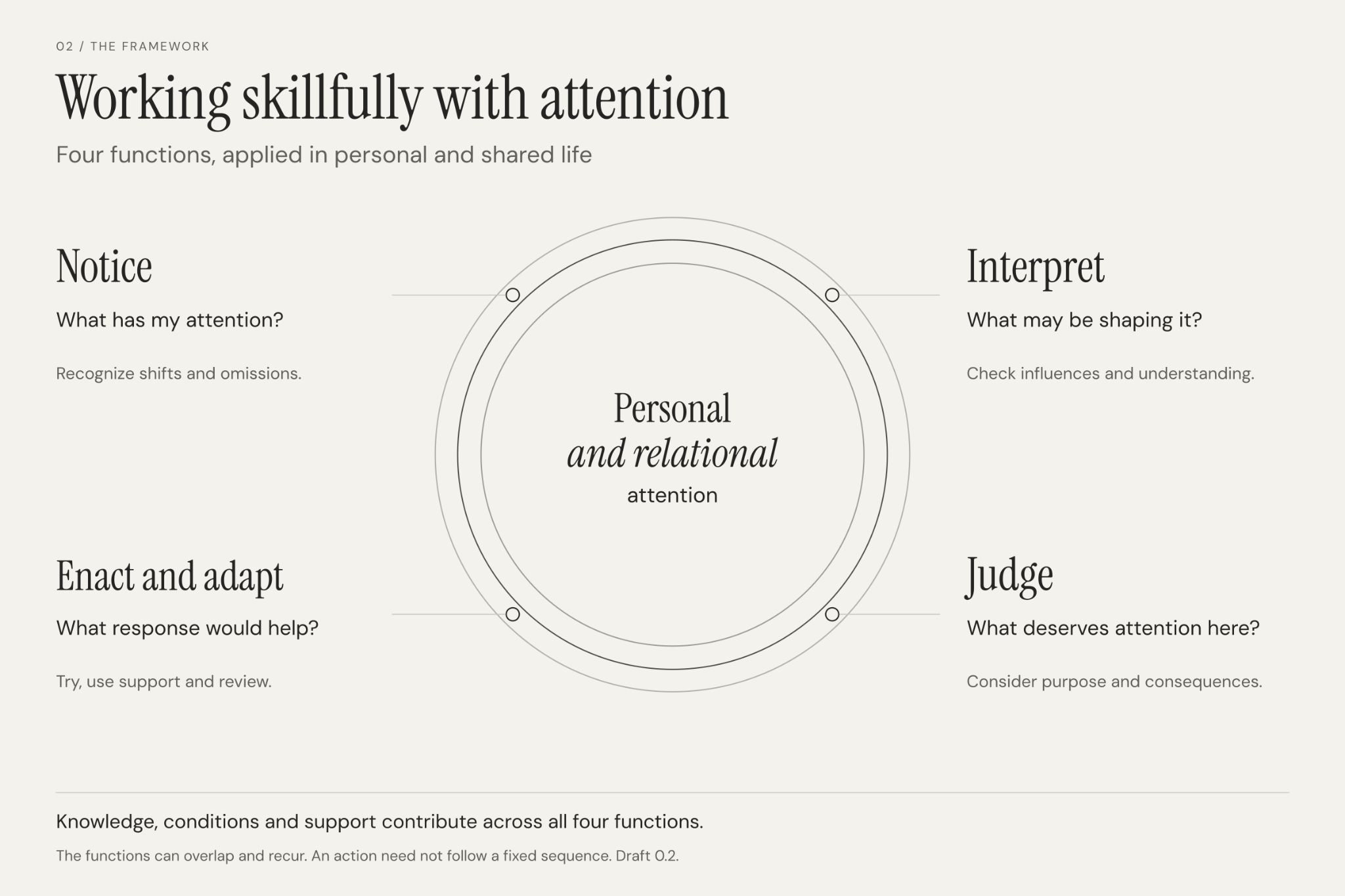
Personal and shared life.
PersonalWhat am I noticing?
The direction of attention, a change in interest, a judgment, or the possibility of staying, shifting, and returning.
RelationalWhom am I hearing?
The other person’s meaning, the space a conversation allows, and the perspectives that might be receiving less attention.
EnvironmentalWhat shapes the field?
The design of a platform, the conditions in a classroom, or the demands of a shared setting. Personal choice takes place within conditions.
Calling attention a public skill expresses the project’s educational and social purpose. It asks how understanding attention might matter beyond individual concentration, including listening, participation, and consideration for others.
Different sources.
Careful distinctions.
The inquiry puts contemplative sources into conversation with cognitive science and education. Each offers different questions, methods, and standards of evidence.
Contemplative inquiry
One source example is MN 10, The Establishing of Mindfulness Discourse. Its section on mind includes recognizing scatteredness and concentration. The text belongs to a Buddhist path with ethical aims; an everyday educational application is an interpretation by this project.
Read MN 10, section C: Mind ↗Attention research
Petersen and Posner’s 2012 review describes attention in terms of multiple networks and functions. It offers background for asking more precise questions about attention. It does not validate Stillwater’s working definition, framework, or educational approach.
Petersen & Posner, The Attention System of the Human Brain: 20 Years After ↗Educational development
The research priority is a competency framework that can inform a developmental pathway for attentional literacy across K–12. A proposed middle school prototype and a later evaluation plan will help make the learning questions concrete.
Read the current work →
The project does not equate mindfulness with attention, treat different contemplative traditions as interchangeable, or assume that a useful practice establishes a scientific mechanism.
Questions still open.
- Which distinctions help people understand their attention without oversimplifying it?
- How might the complexity of attentional skills develop across K–12, and what would show useful learning?
- How can learning account for different people, settings, and possibilities for choice?
- What should a framework include about listening and shared life?
- What does this framework contribute alongside existing work on mindfulness, metacognition, self-regulation, and media literacy?
- What evidence would be needed to judge the usefulness of an educational approach?
The next stage is to make these questions specific enough to examine, review, and revise.